
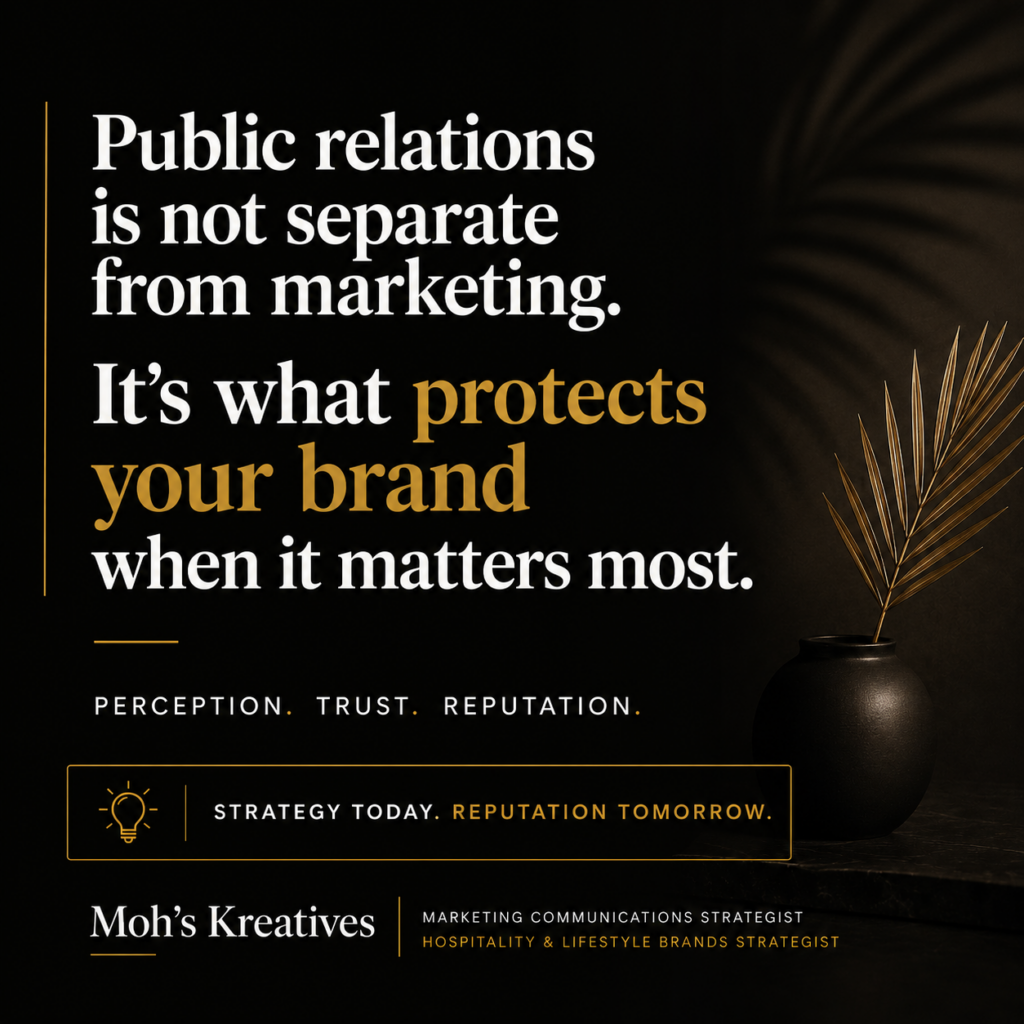
There’s a quiet assumption many businesses make about communication: that it exists to promote.To showcase products, announce offers, highlight features, and share positive feedback.And while all of that is important, it is only one part of the story because communication does not just inform; It shapes perception and perception, more than anything else, determines whether people trust you, engage with you, and choose you.This is where public relations becomes a critical, often overlooked part of marketing, and where the role of a marketing communications strategist becomes essential.
Beyond Promotion: What Public Relations Actually Does
Public relations sits at the intersection of visibility and trust. If marketing is responsible for getting
people’s attention, PR is responsible for shaping what they believe once they are paying attention.
It influences:
how your brand is perceived over time
how consistently your message is communicated
how you handle moments that are not entirely positive
In other words, PR is not just about telling your story, It is about ensuring your story remains credible.
For any marketing strategist, this distinction is critical. Because growth without trust is not sustainable.
Marketing Communications Without PR is Incomplete
When PR is missing from marketing communications, brands tend to default to one-way messaging:
“This is what we offer”
“This is why we’re great”
“This is why you should choose us”
But audiences today are not passive.
They question, they observe, they compare and most importantly, they talk. And in a digital
environment, those conversations are visible, searchable, and permanent. This is particularly true for
hospitality and lifestyle brands, where experience and perception are closely tied. What people say
about your brand often carries as much weight as what you say about yourself. This means
communication cannot only be about promotion. It has to account for perception in real time.
Public Relations is not just about spinning narratives, contrary to popular belief, it is actually about
transparency. Transparency is not a buzzword. It is a strategy. Especially when something goes wrong. In
moments of friction, uncertainty, or dissatisfaction, communication shifts from marketing to
accountability. At that point, silence is not neutral neither is selective communication. When concerns
are handled quietly, behind the scenes, or inconsistently, a gap begins to form:
between what the brand says
and what the audience experiences
That gap is where trust starts to erode. For a hospitality and lifestyle brands strategist, these moments
are not optional considerations. They are critical points that define long-term brand perception.
Crisis Communication is Reputation Management
Crisis communication is often misunderstood as damage control. In reality, it is reputation management
in real time. It answers questions like:
Who speaks for the brand?
How quickly do we respond?
What tone do we take?
How much do we share, and when?
These decisions shape how a brand is remembered long after the situation has passed. The brands that
navigate crises well are not necessarily the ones that avoid issues altogether. They are the ones that:
acknowledge concerns early
communicate clearly and consistently
take responsibility where necessary
and remain visible throughout the process
This is where structured thinking from a marketing communications strategist becomes invaluable,
because these decisions cannot be improvised under pressure.
The Cost of Poor Communication
When communication is reactive, inconsistent, or unclear, the consequences are rarely immediate, but
they are significant.
trust declines
credibility weakens
public narratives begin to form without the brand’s input
once perception shifts, it becomes much harder to rebuild.
Building with Intention
Public relations should not be introduced only when things go wrong. It should be built into your
marketing communications from the beginning.
This means:
having clear communication structures
defining who speaks and how
aligning messaging across all touch points and preparing for moments that require more than promotion
This is the approach we take at Moh’s Kreatives, where strategy is not limited to visibility, but extends to
how brands are perceived, trusted, and sustained over time.
Every brand communicates, but not every brand communicates with intention; And when things go
wrong, that difference becomes very visible. Public relations is what ensures that your communication
does not just attract attention, but sustains trust. In today’s environment, that is not optional. It is
foundational.